ADDITIONAL ITEMS ASSEMBLE THE EQUIPMENT DATA POST WAR 44
With the war in the far-east thought to be likely to continue in to 1947, the equipment issued for use on this front was found to be wanting, a commission was established to to investigate and recommend changes. This would eventually lead to a whole new set of equipment in uniforms webbing and accoutrements. The webbing that came from this would be introduced as the 1944 Pattern web equipment.
The following is based on The Pattern 1944 Web Equipment booklet published buy the War Office 25th June, 1946
1. Purpose.-The equipment incorporates a new principle of design to enable the load carried to be evenly distributed and well balanced. It was first designed for use in the tropics but has proved equally sutaible for all conditions of modern warfare. The main object has been to reduce the weight of the equipment and to maintian adequate stength in its construction to carry everything needed. This has been achieved by using fine yarn to reduce the thickness of the various types of webbing, and light alloy fittings which have been darkend. The yarn used for the webbing is dyed and rotproofed before being woven.
2. Characteristics.- There are three princple features in the new design of equipment:- A) A method of supporting the heavy contents of the large basic pouches to prevent down dragof the equipment in front without counter-balance by weight on the back. To do this the braces form a sling : they are joined at the back where they cross and are fixed to the belt immediately at the rear of the basic pouches.
B) An increase in the carrying capcity of the haversack and its additional fittings, and also an increase in size of the basic pouches .
C)The equipment has been so designed that, if necessary, and when orerating in tropical arreas, the waistbelt can be worn loose without affecting the carriage of the equipment.
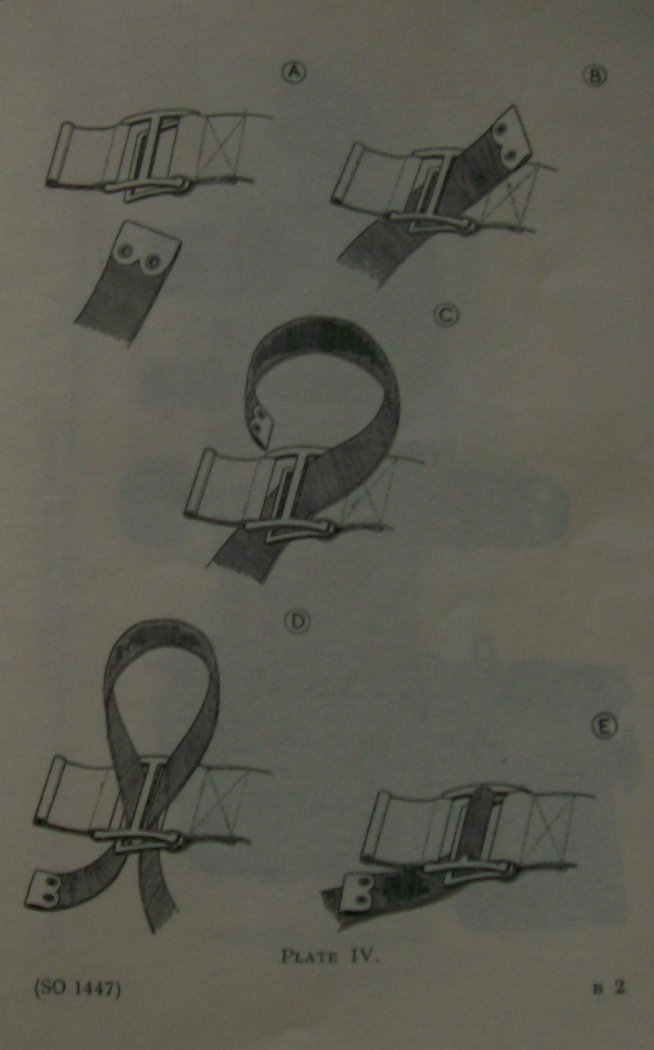
3. Fittings.- The three quater inch, 1 inch and 2 inch 3-bar buckles and the 1 inch 4-bar buckle used have narrow spaces and the bar of each buckle to which the webbing is sewn is raised, to grip the straps securely and to prevent slipping througth movement when the euipment is assembled. The shoulder and haversack straps are fitted with a 3/4 inch quick release buckle. This consists of two pieces : the upper with a centre bar and the lower without.
A) Pass the loose end of the strap up through both pieces, over the bar on the upper and down through both pieces.
B) The strap goes from back to front of the pieces, that is, from the side where bothpieces are joined to the strapto the side where they are open.
C) To tighten the strap pull the loose end. If fastened correctly it will not slip.
D) To release pull the short tab on the upper piece upwards and backwards.
The same buckle , 1 inch wide is also fitted to the shoulder straps but without a tab as quick-release is not essential. Instead of the former snap fasteners a quick release type is used on the basic pouches ; this consists of a staple and link with a web tongue and tab for the securing and release . Similar fasteners are provided to close the pockets on the sides of the haversack
Equipment for Officers, Warrant Officers, N.C.Os. 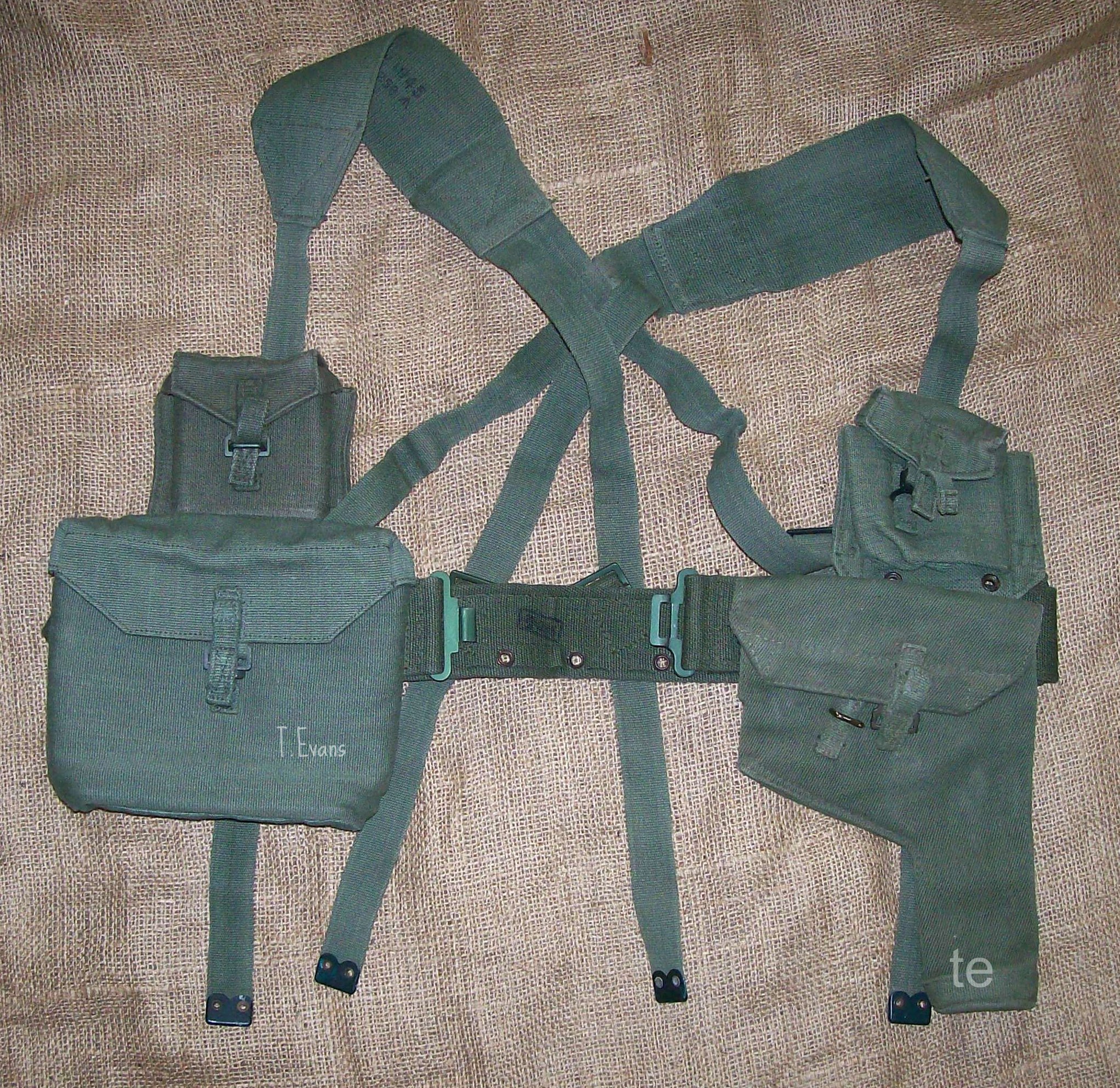
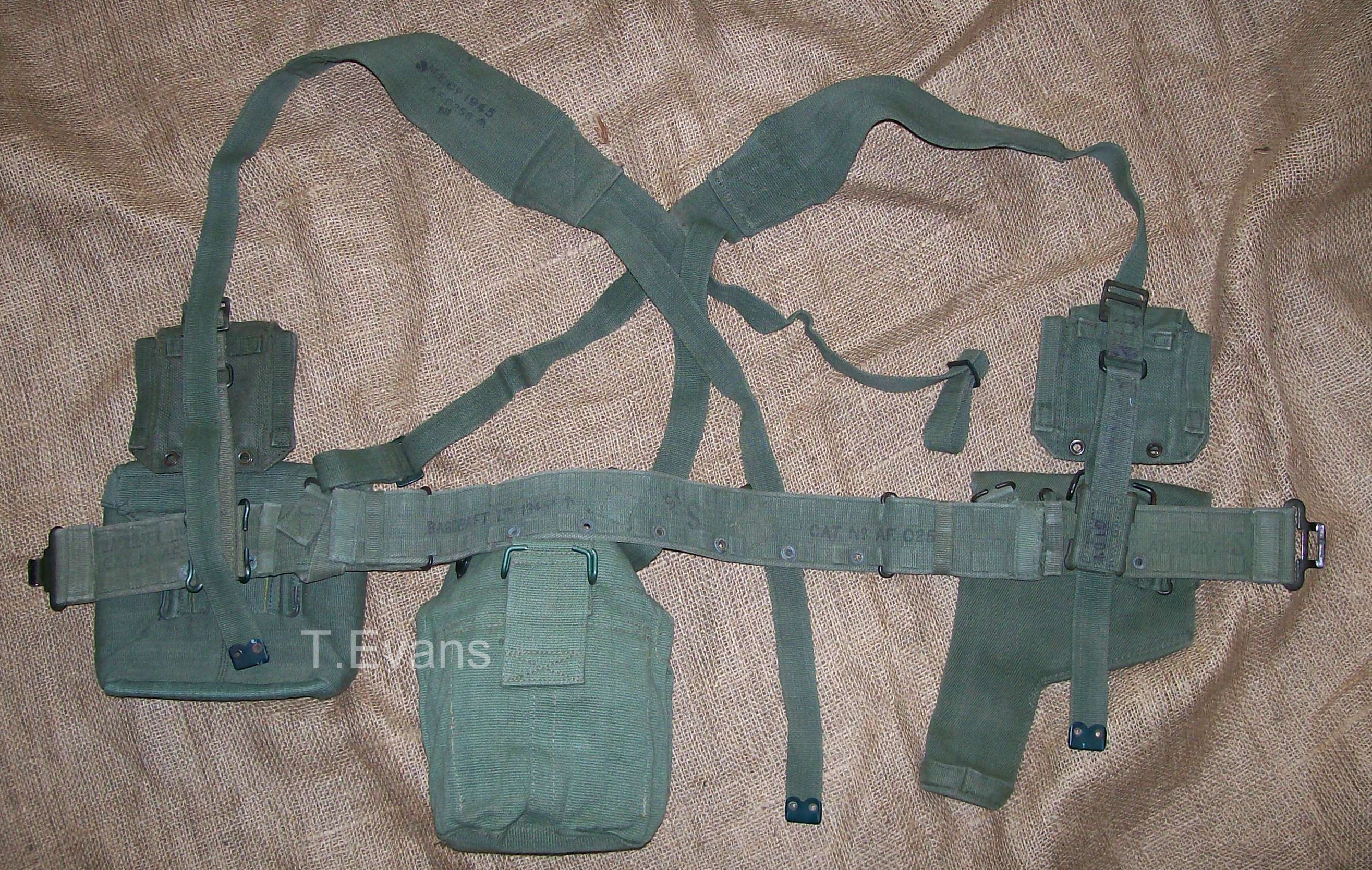
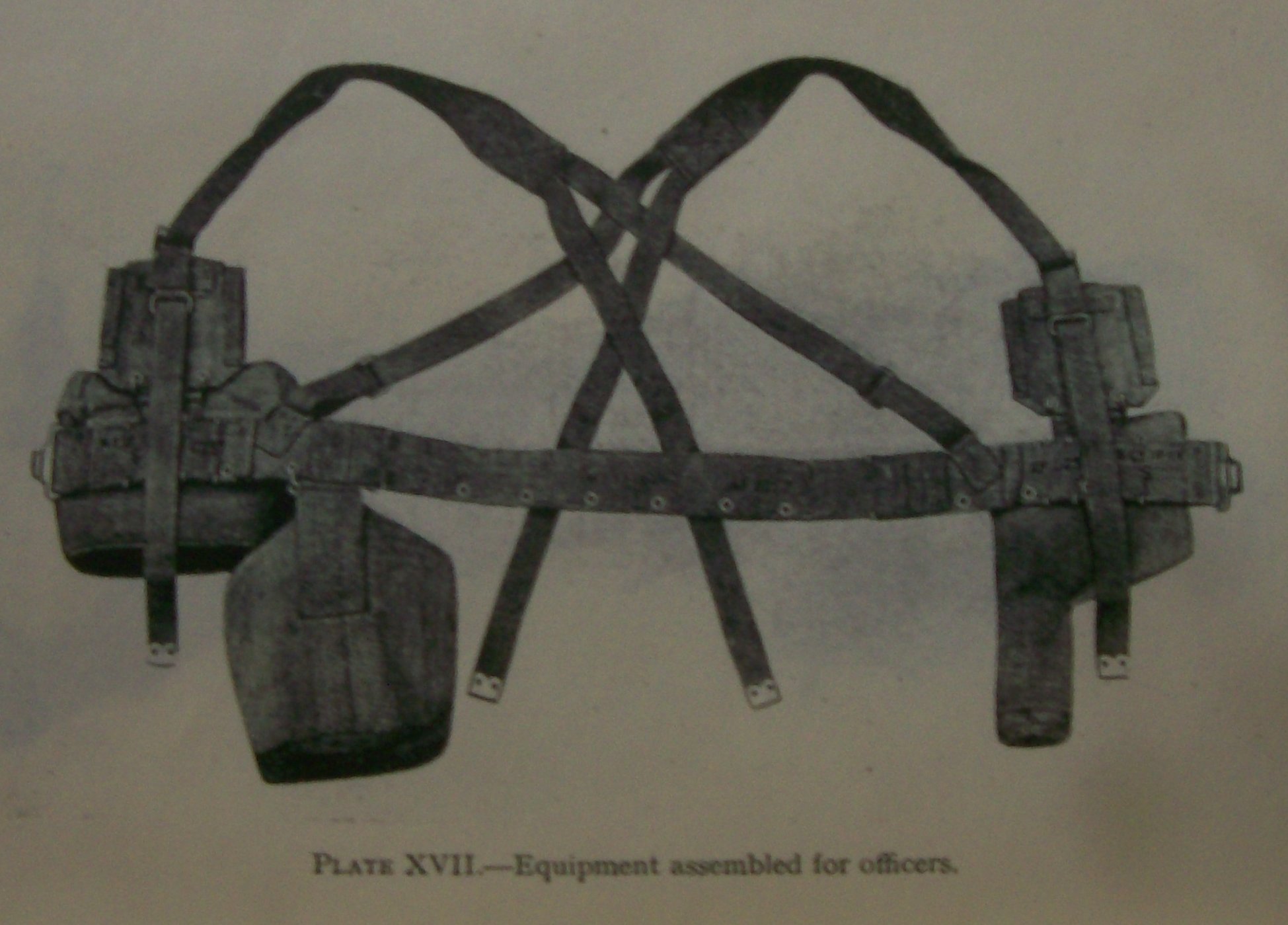
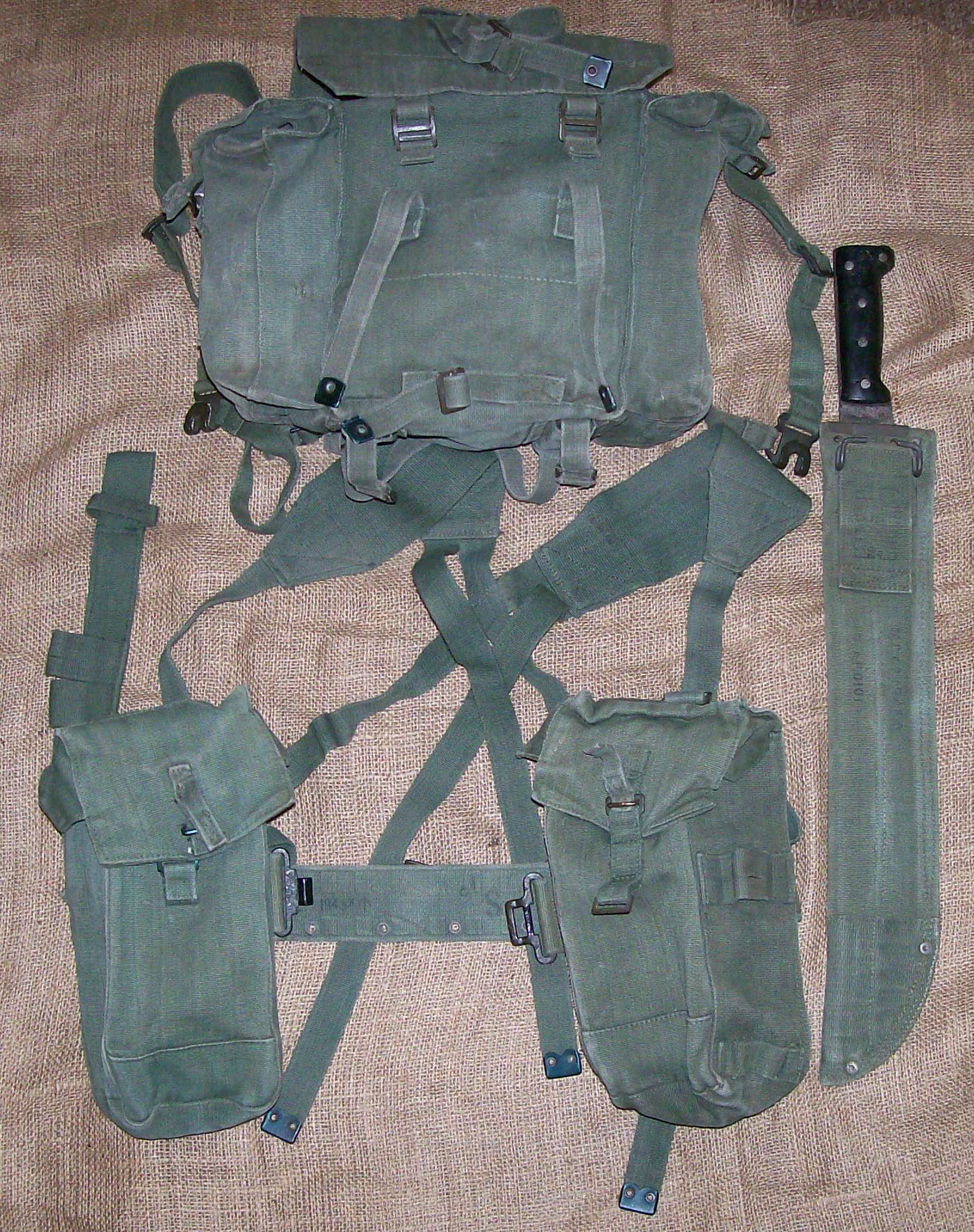
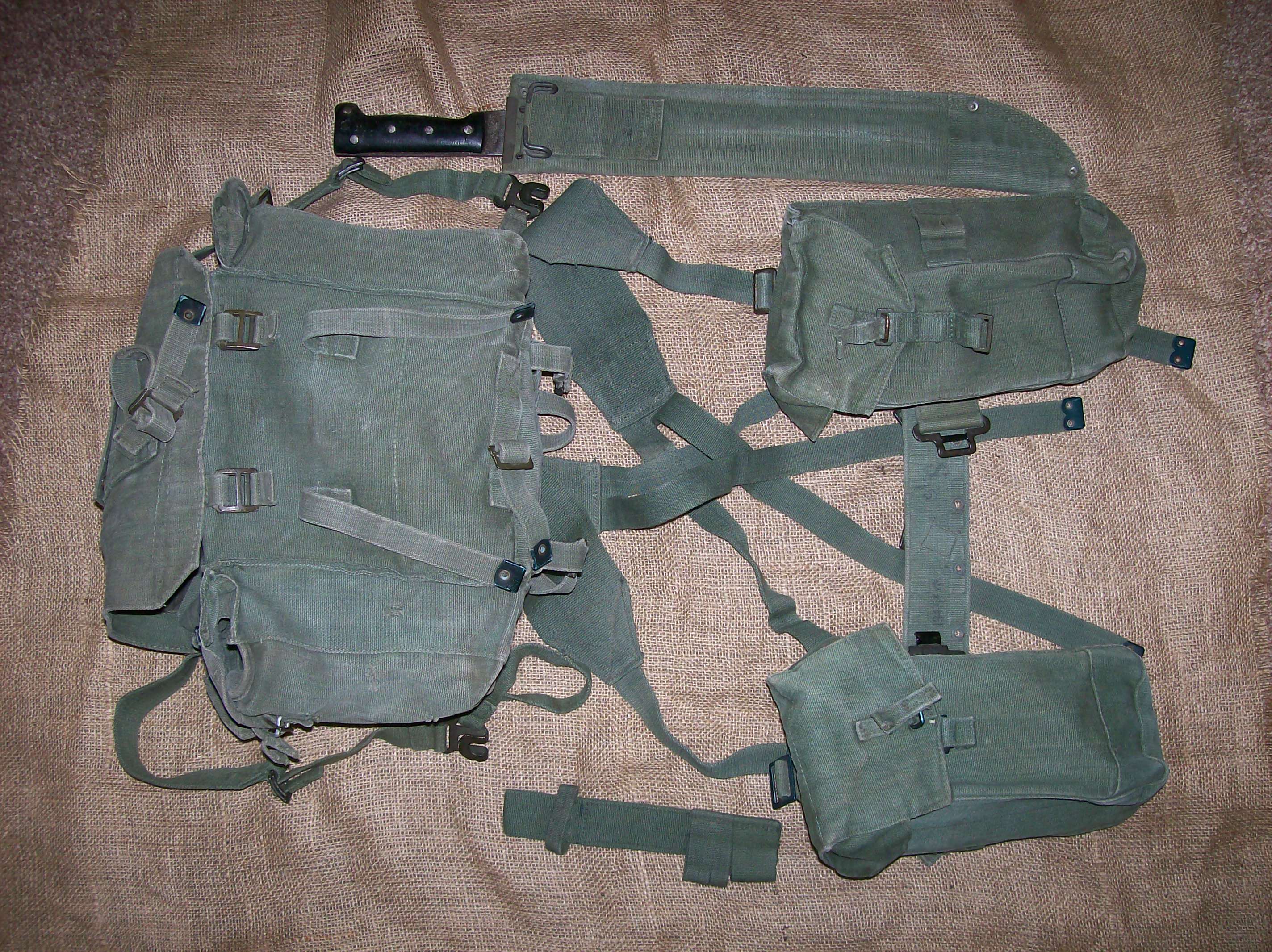 Equipment set for the Rank and File,
(a) Waistbelt .-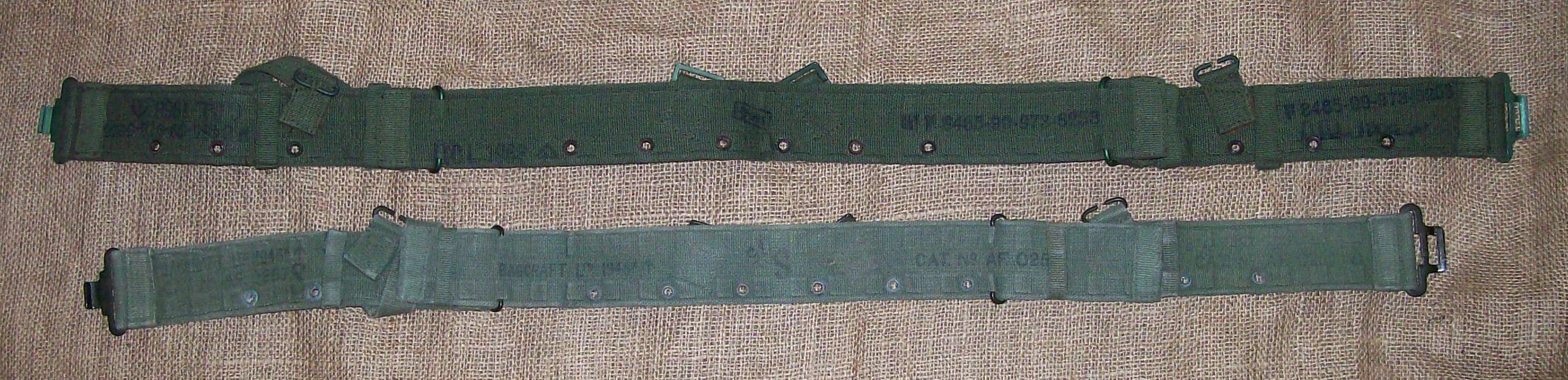
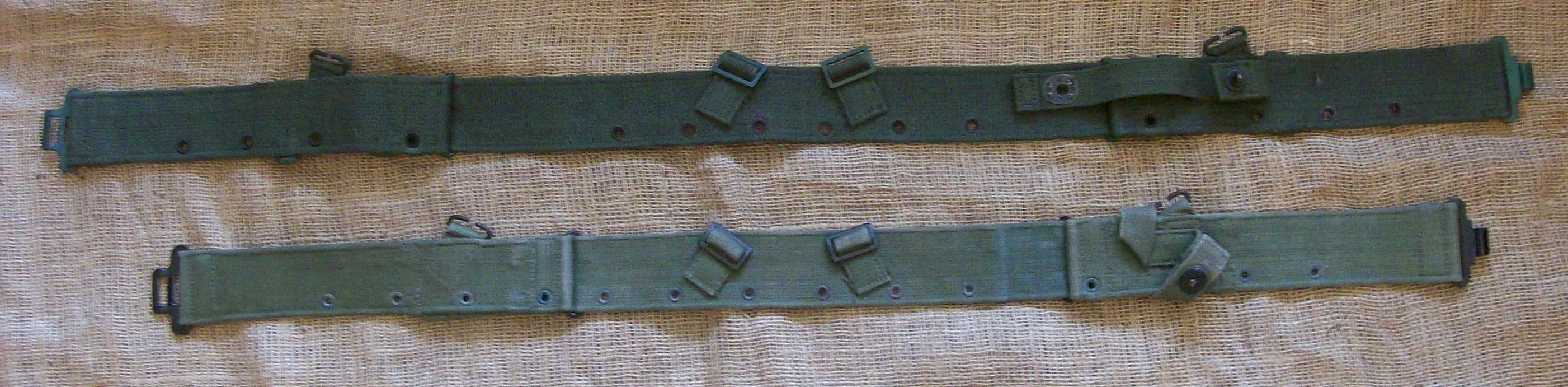 This was issued in two sizes, large 48 inches and normal 40 inches,(note picture shows bottom belt marked S for small, when manual states only large and normal sizes) it was essitmated that normal would fit 95% of troops. It was made in 2 inch wide webbing and came in 3 pieces (two sides and an adjustment strap) A closing bukcle of the "hook and loop" type is fitted to the front ends of the side piecies the same style of buckle used on the 1937 pattern belt, the rear section had double hooks on each end ; a 1 inch link with gap is fitted diagonally to each side piece for attachment of the braces ; loops are provided for the spare ends of the adjustment strap. Two 1-inch 3-bar buckles are fitted to the back piece for attachment of the inner braces. Grommets (i.e. eyelets with spur tooth washers) are fitted in the lower edge--four in each side piece and six centrally spaced in the adjustment strap ; a 1 inch strap with snap fastener (LTD lift the dot) is fitted to the right hand side piece to secure the rifle when slung on the shoulder.
(b) Bayonet frog.-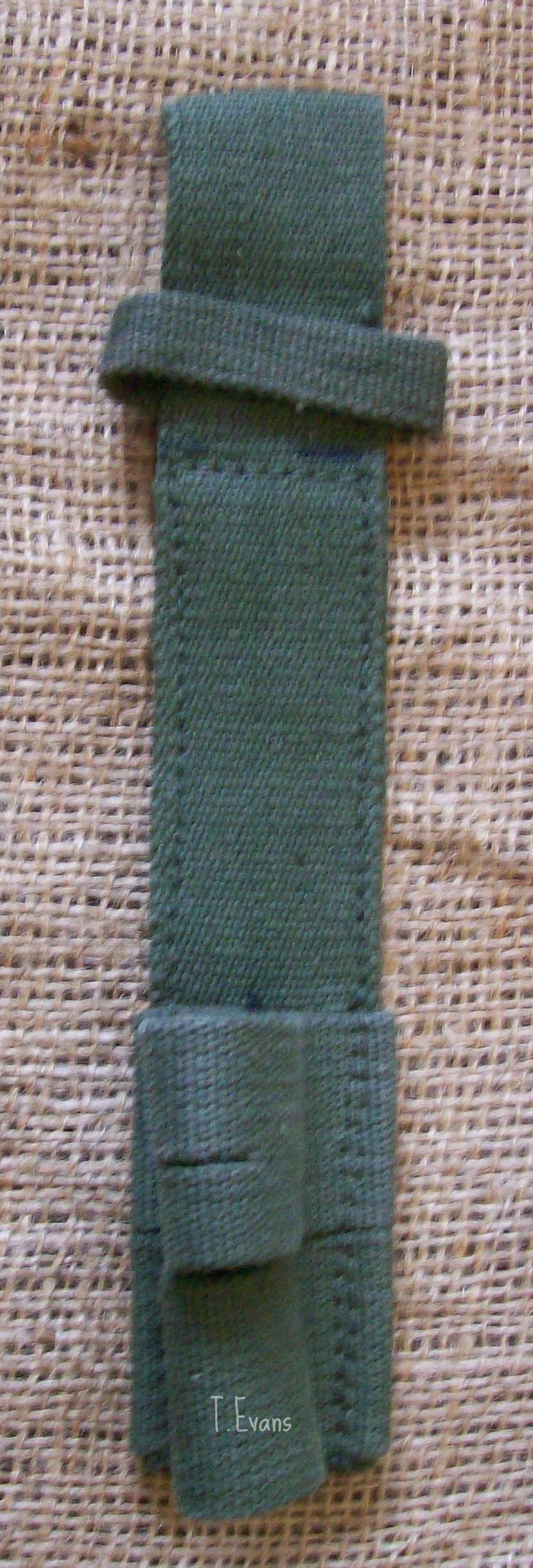
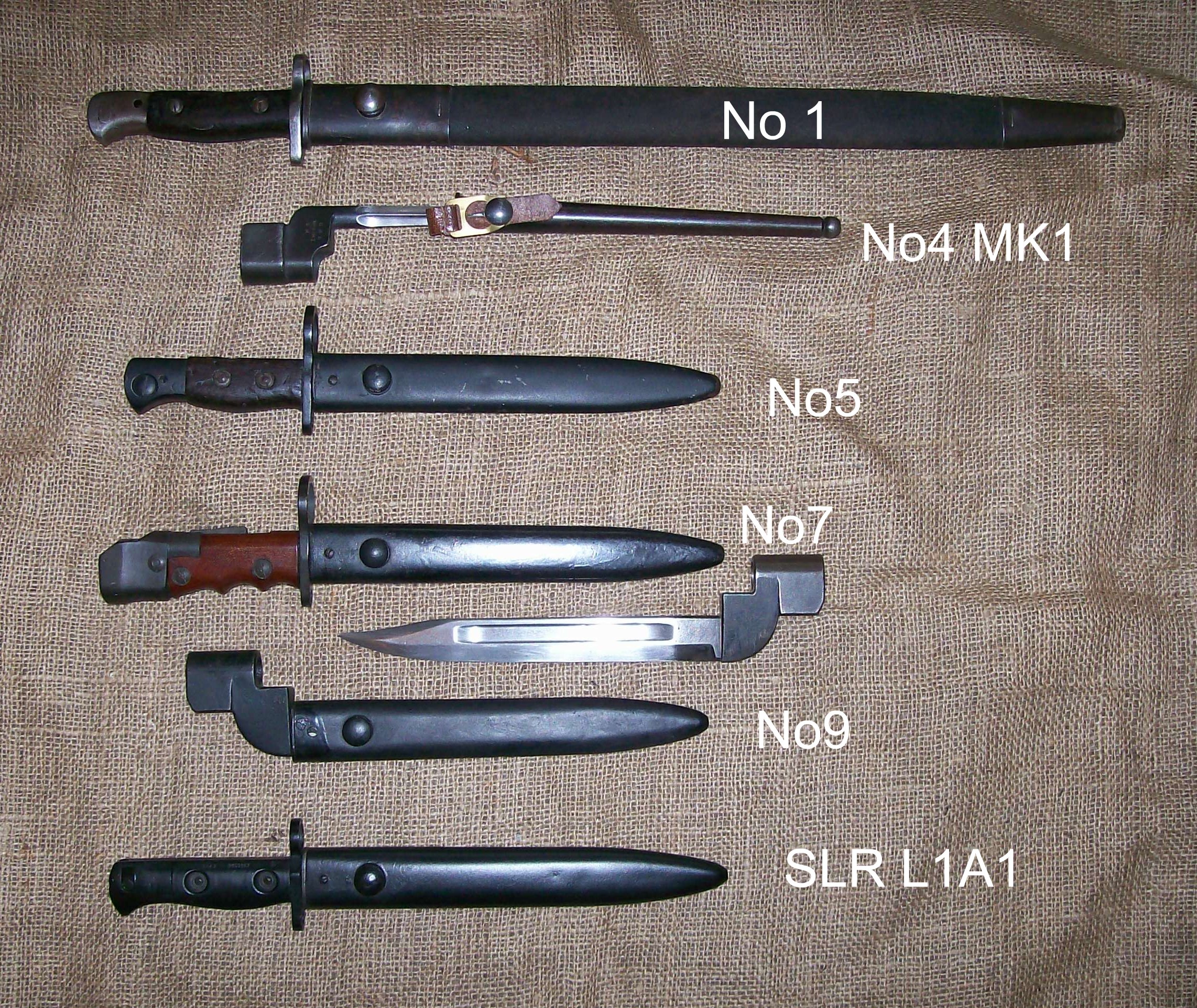
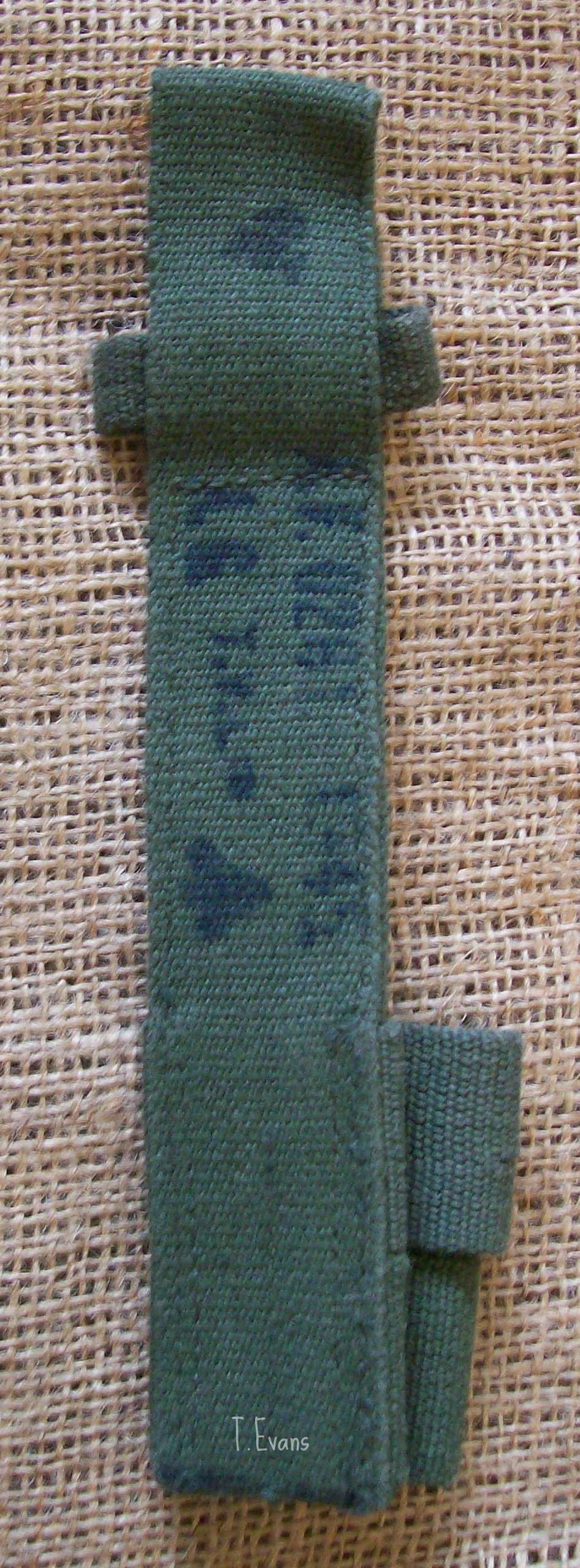 This is provided with a woven hole in the upper scabbard loopto enable the (Pic) No.4, No5 or No.7 bayonet to be carried by inserting the stud througth the hole. The No.1 bayonet is held in the frog in the usual way by the stud on the scabbard being inserted between the web loops. A narrow web loop is provided to slip over the hilt of the No.1 or the No5 bayonet to prevent swinging.
(c) Basic pouch Left.-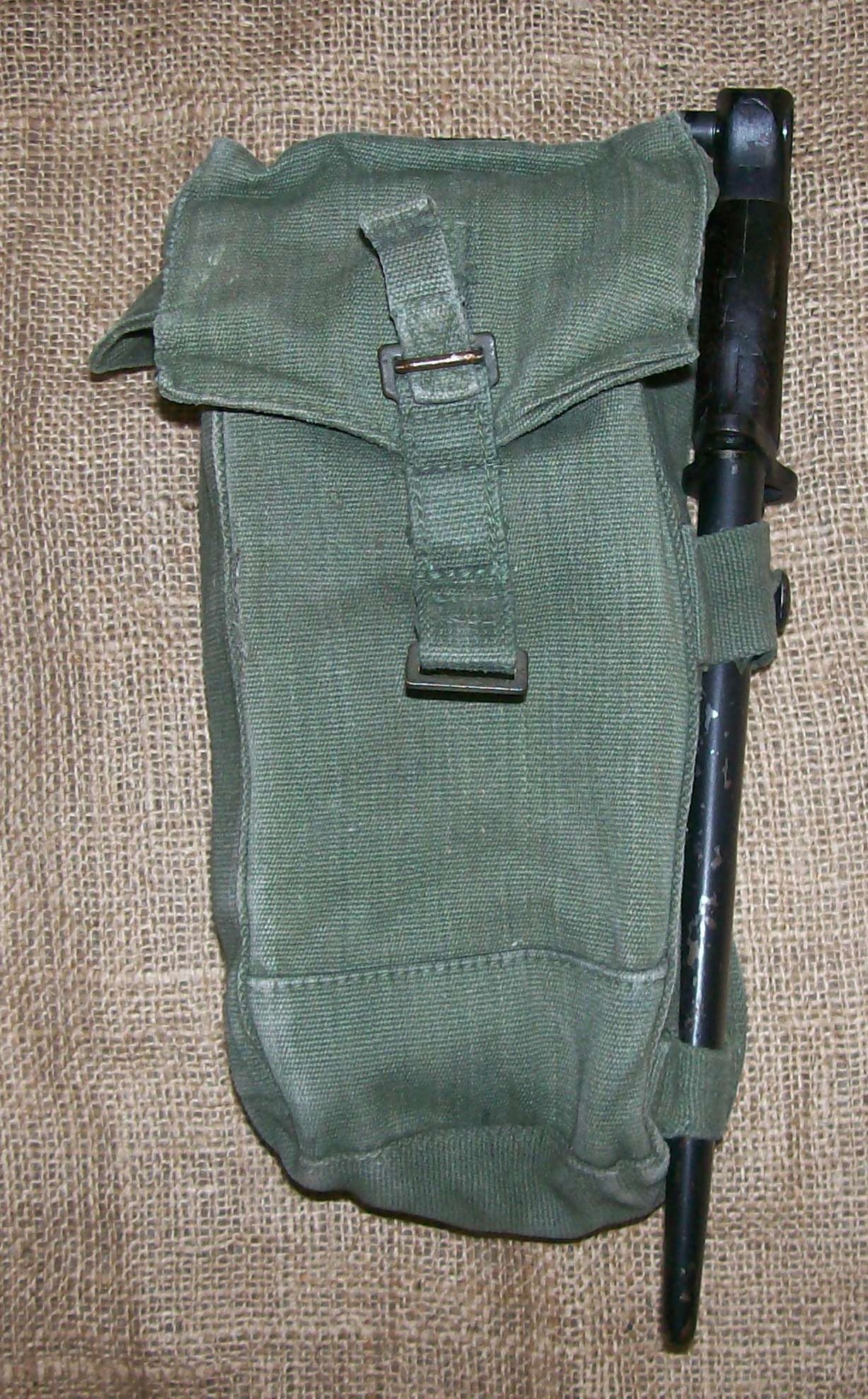
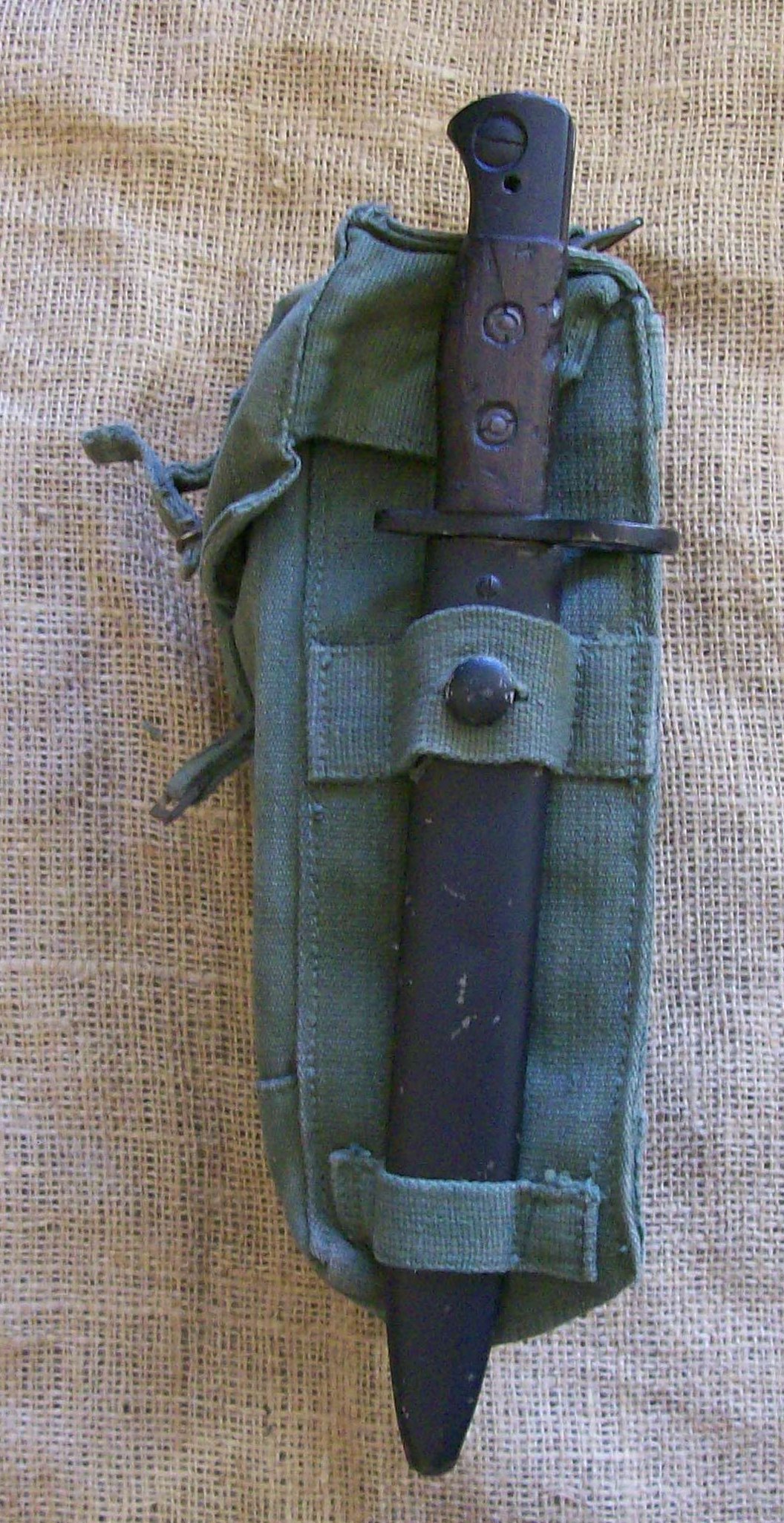 The internal dimensions are approximately 4 1/2 inches by 3 inches by 91/2 inches deep. On the back, two 2-inch wire hooks are provided for connecting to the waistbelt, a
 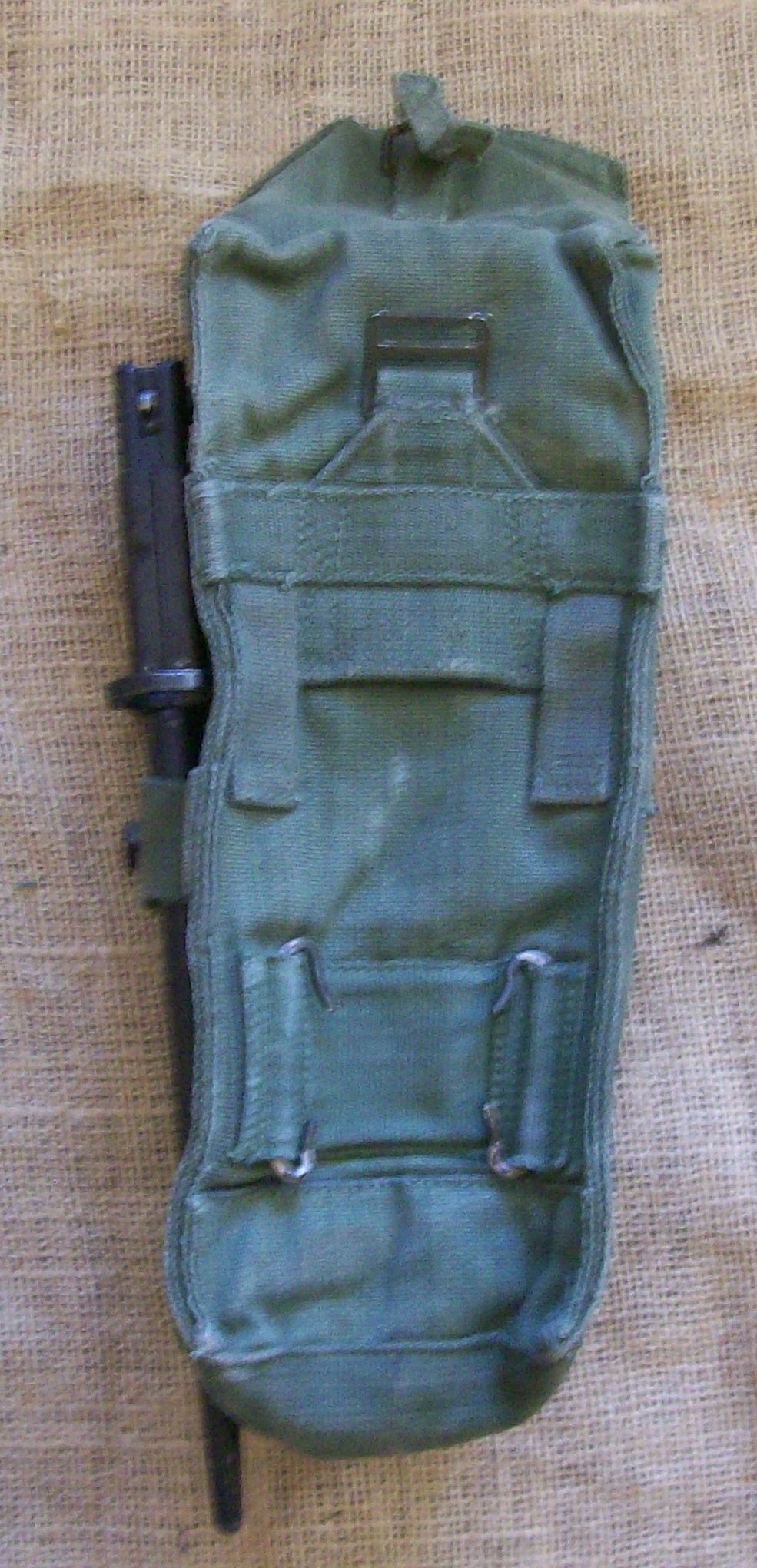 taperd chape with 1-inch 4-bar buckle for the braces and two vertical webbing loops for the haversack straps ; the hooded flap is fitted with the staple portion of a quick-release fastener which can be fitted to either of the two links on the front of the pouch . The normal method of closure is to use the bottom link ; the alternative method is for use when longer items are carried in the pouch. The left hand side has loops as an alternative method of carring the No 4, 5 and 7 bayonet.
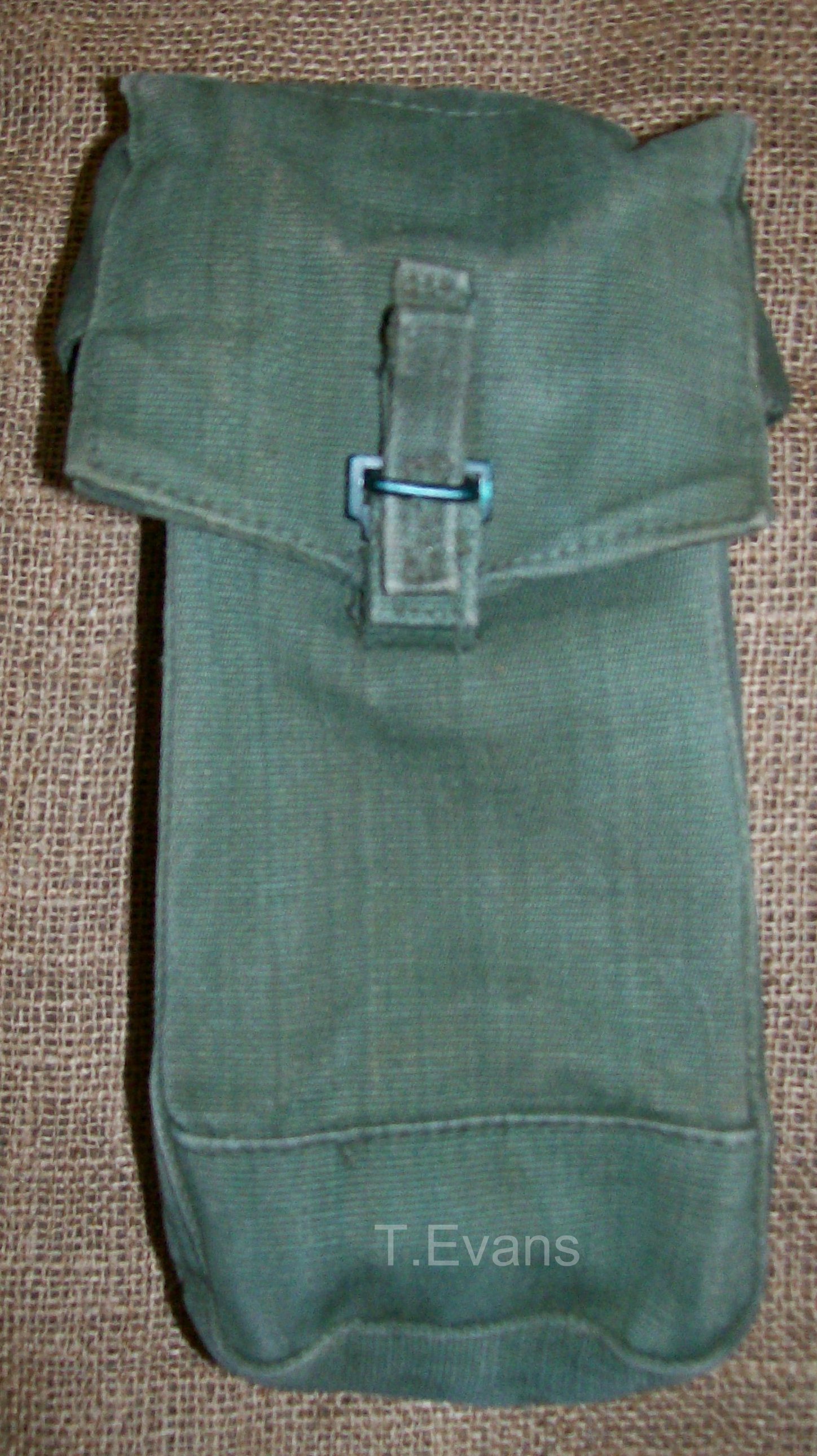 (d) Basic Pouch, Right.- Exactly the same as the left pouch except that bayonet loops are not fitted on the side.
(e) Braces (pair).- 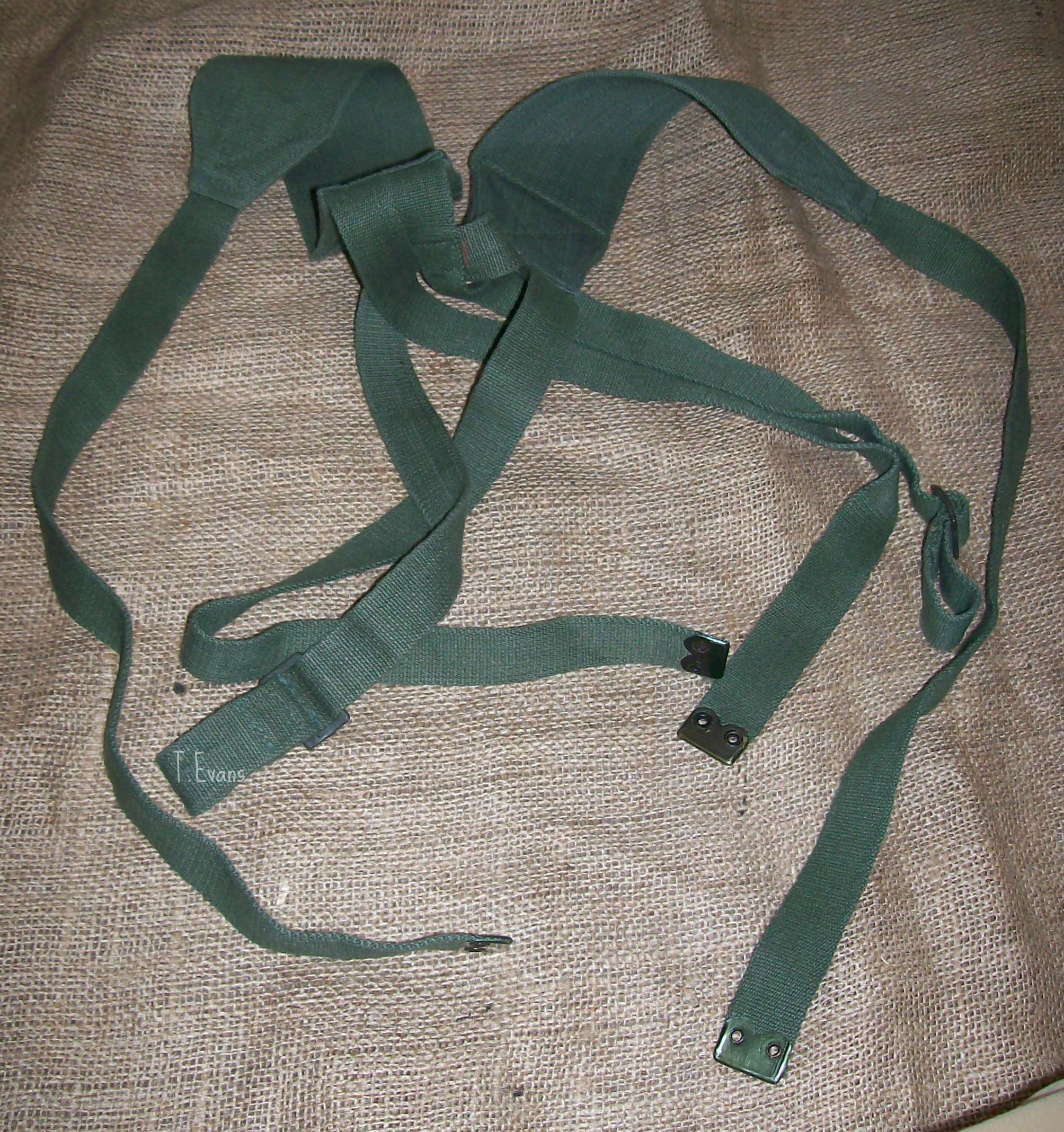 These have shoulder sections made of webbing 3 inches wide, with 1-inch wide front straps to connect to the basic pouches ; two 1-inch straps are sewn to the rear ends of the shoulder sections and stiched where they cross ; when fitted these are adjustable by the 3-bar buckles. The other two 1-inch straps which are not sewn where they cross are for attachment to the buckles on the back of the waistbelt.
(f) Waterbottle cover carrier-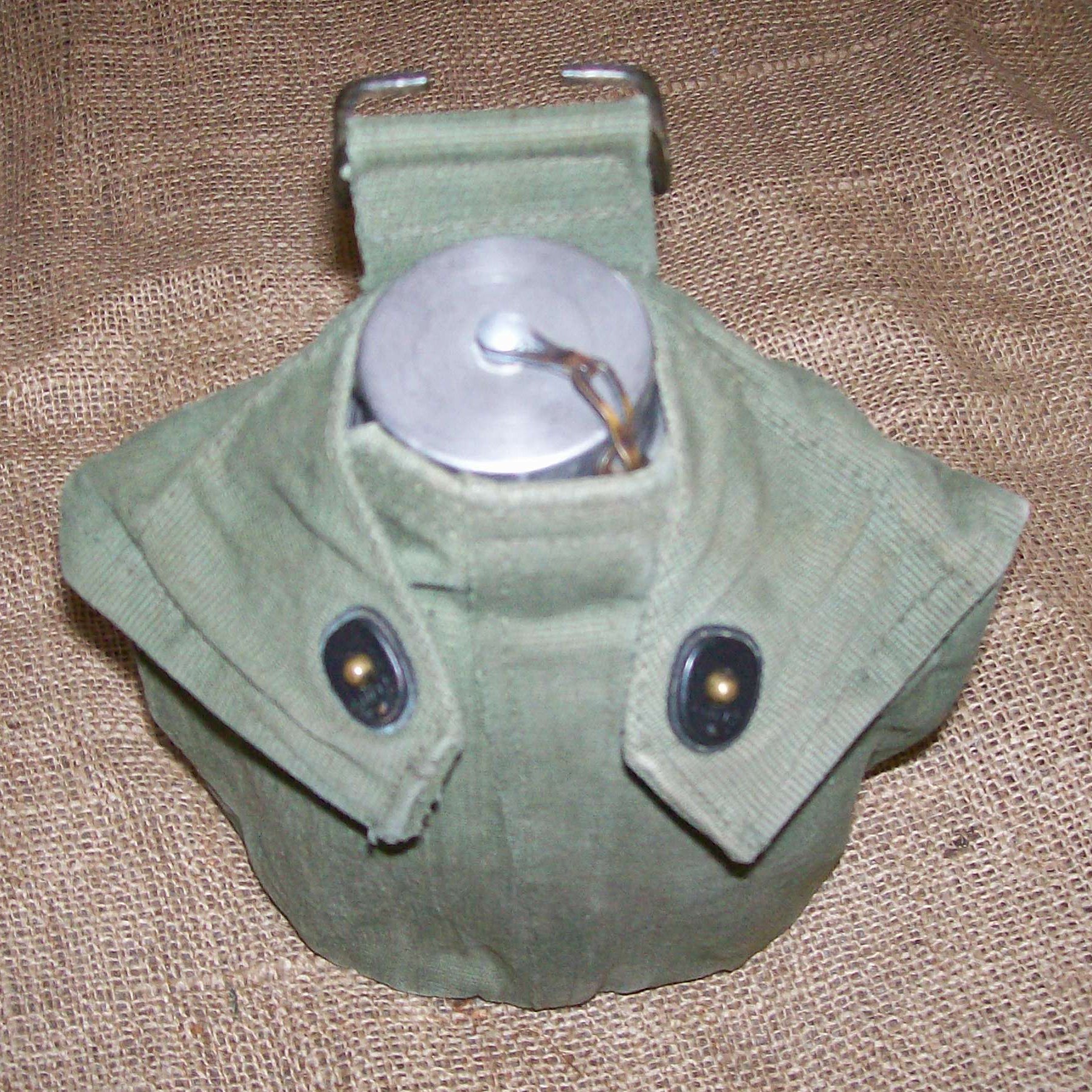
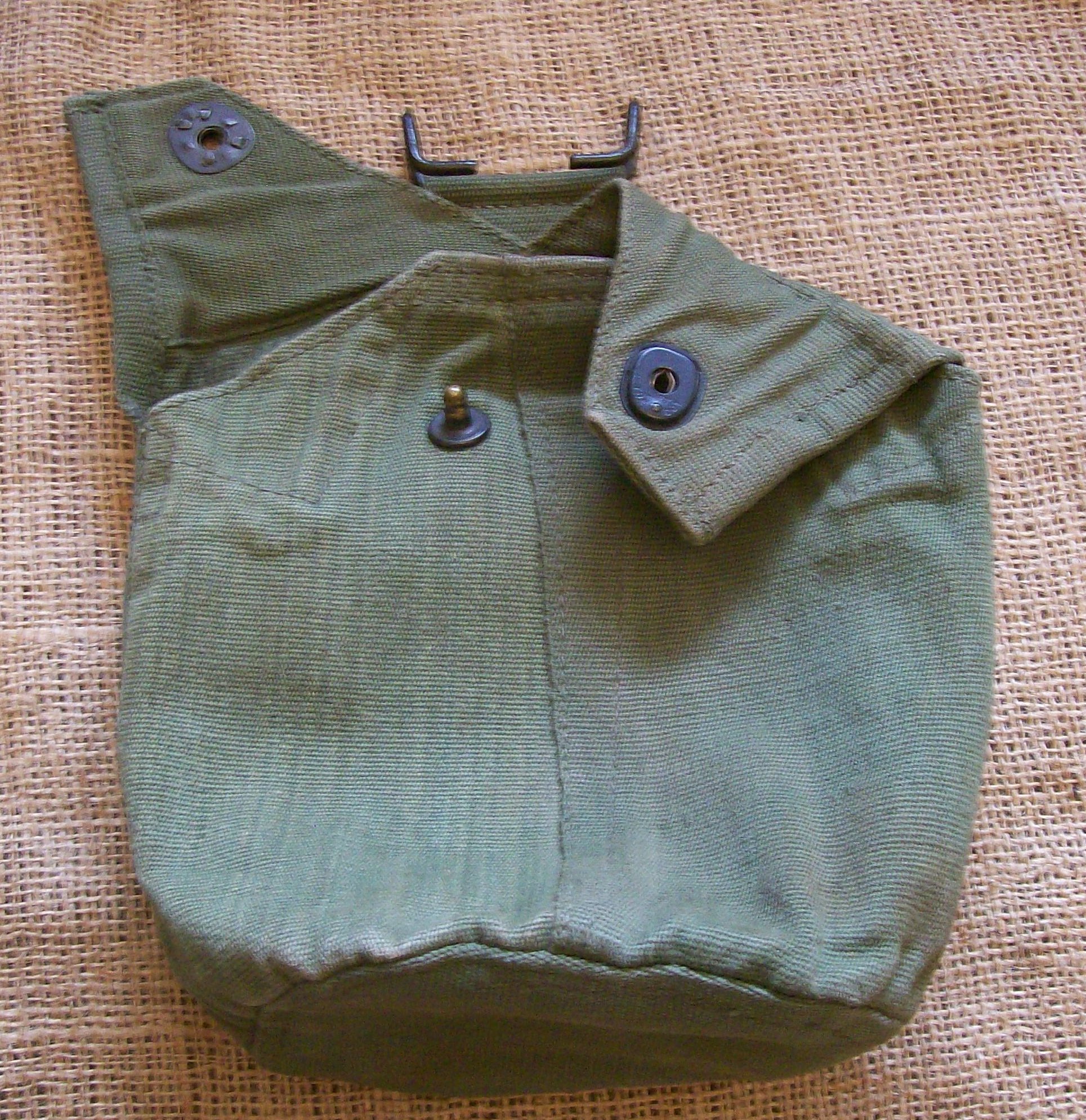
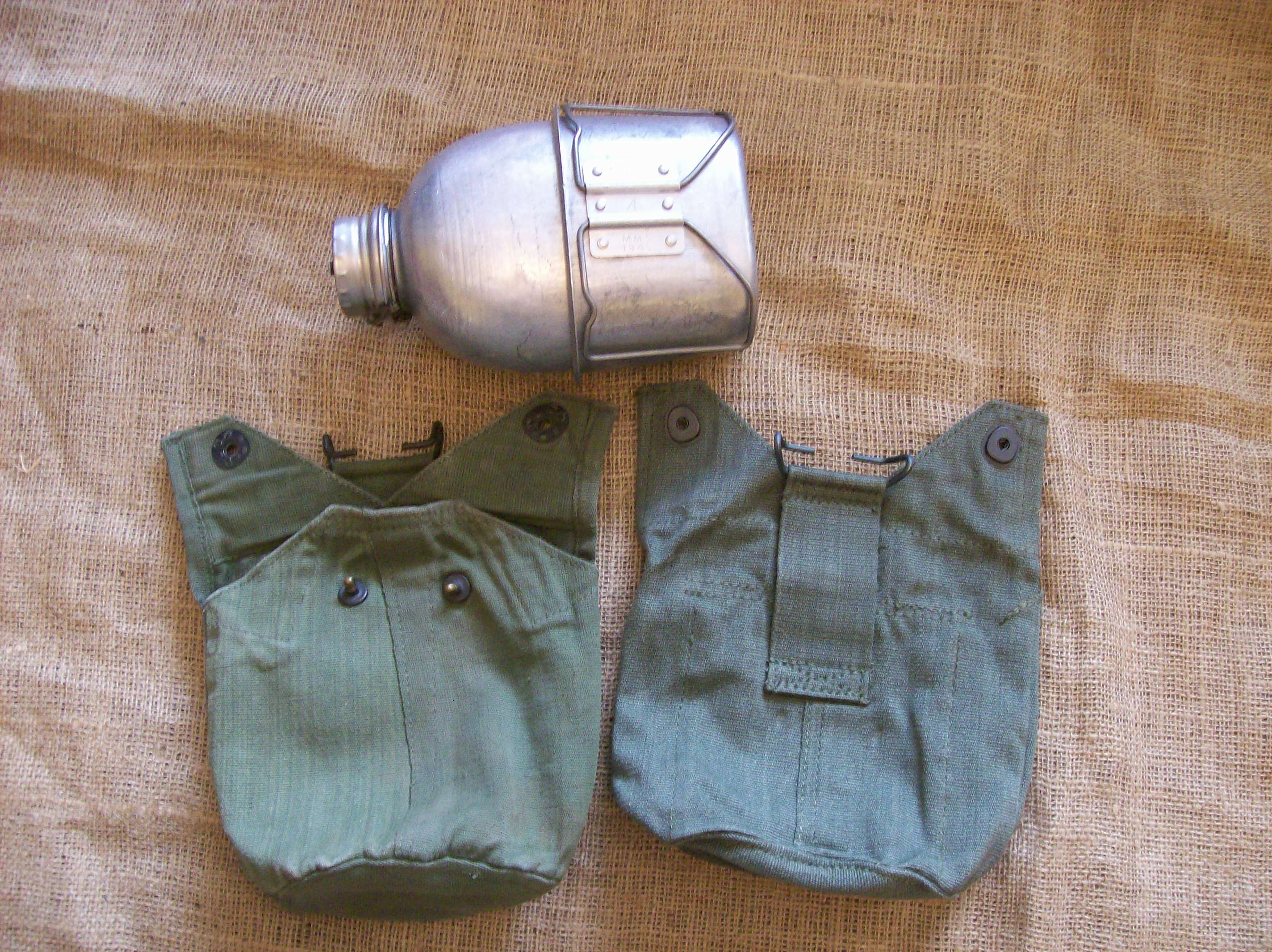
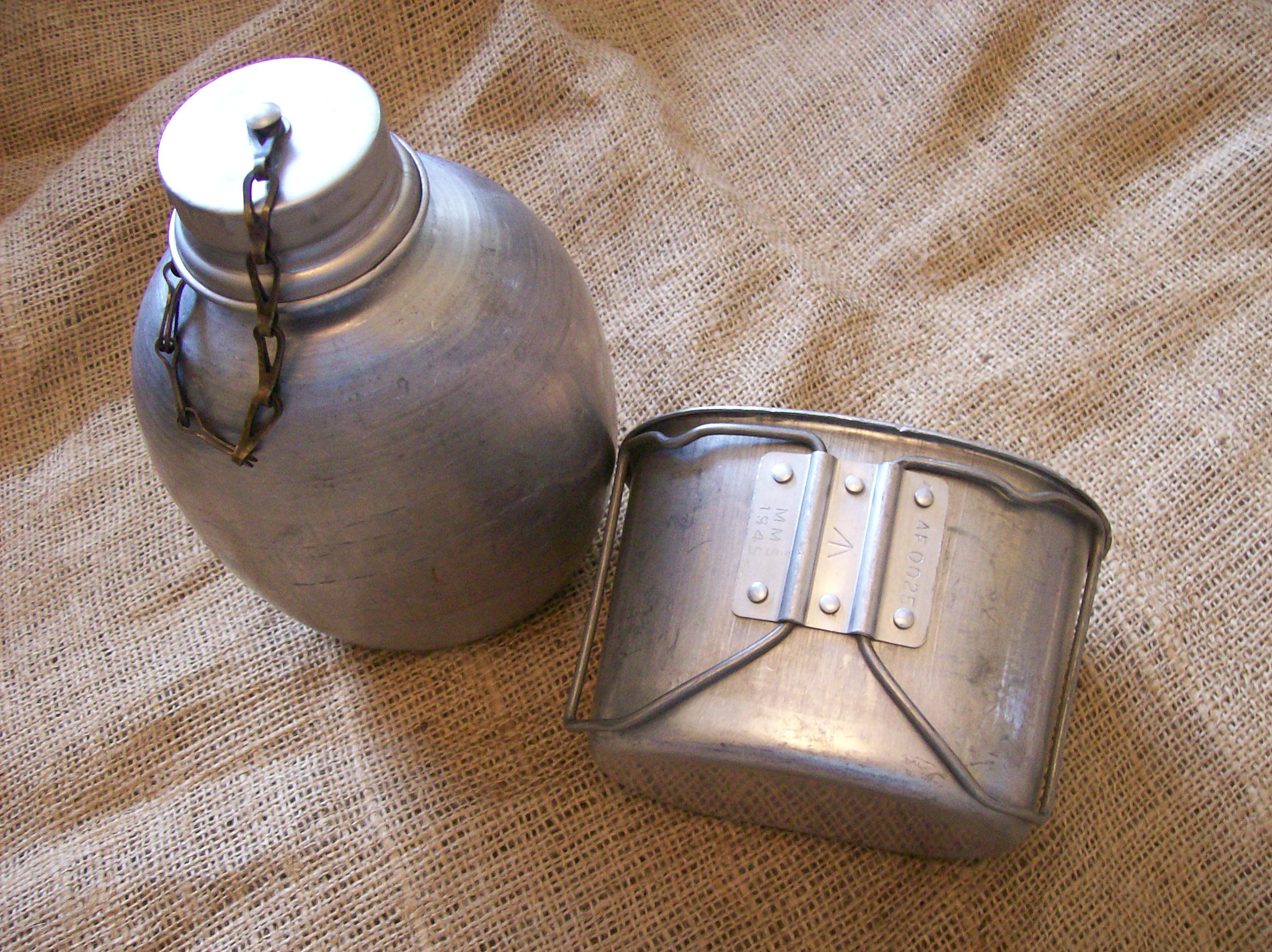 This is a "bag" type to take the new aluminium waterbottle and cup. A pocket is provided inside on the back for the filter bag and has a small flap which prevents the bottle catching the top of the pocket ; a web loop is fitted inside to take a tube of sterilizing tablets ; the bottle is retained in the cover by flaps over it shoulders secured by snap fastners. On the back a "hanger" hook is fitted for the attachment to the grommets in the right side of the waistbelt. (The
waterbottle is of aluminium with screw stopper and alumimium cup on the
base; the bottle has a capacity of one quart and the cup one pint).
This is a "bag" type to take the new aluminium waterbottle and cup. A pocket is provided inside on the back for the filter bag and has a small flap which prevents the bottle catching the top of the pocket ; a web loop is fitted inside to take a tube of sterilizing tablets ; the bottle is retained in the cover by flaps over it shoulders secured by snap fastners. On the back a "hanger" hook is fitted for the attachment to the grommets in the right side of the waistbelt. (The
waterbottle is of aluminium with screw stopper and alumimium cup on the
base; the bottle has a capacity of one quart and the cup one pint).
(g) Haversack.- 

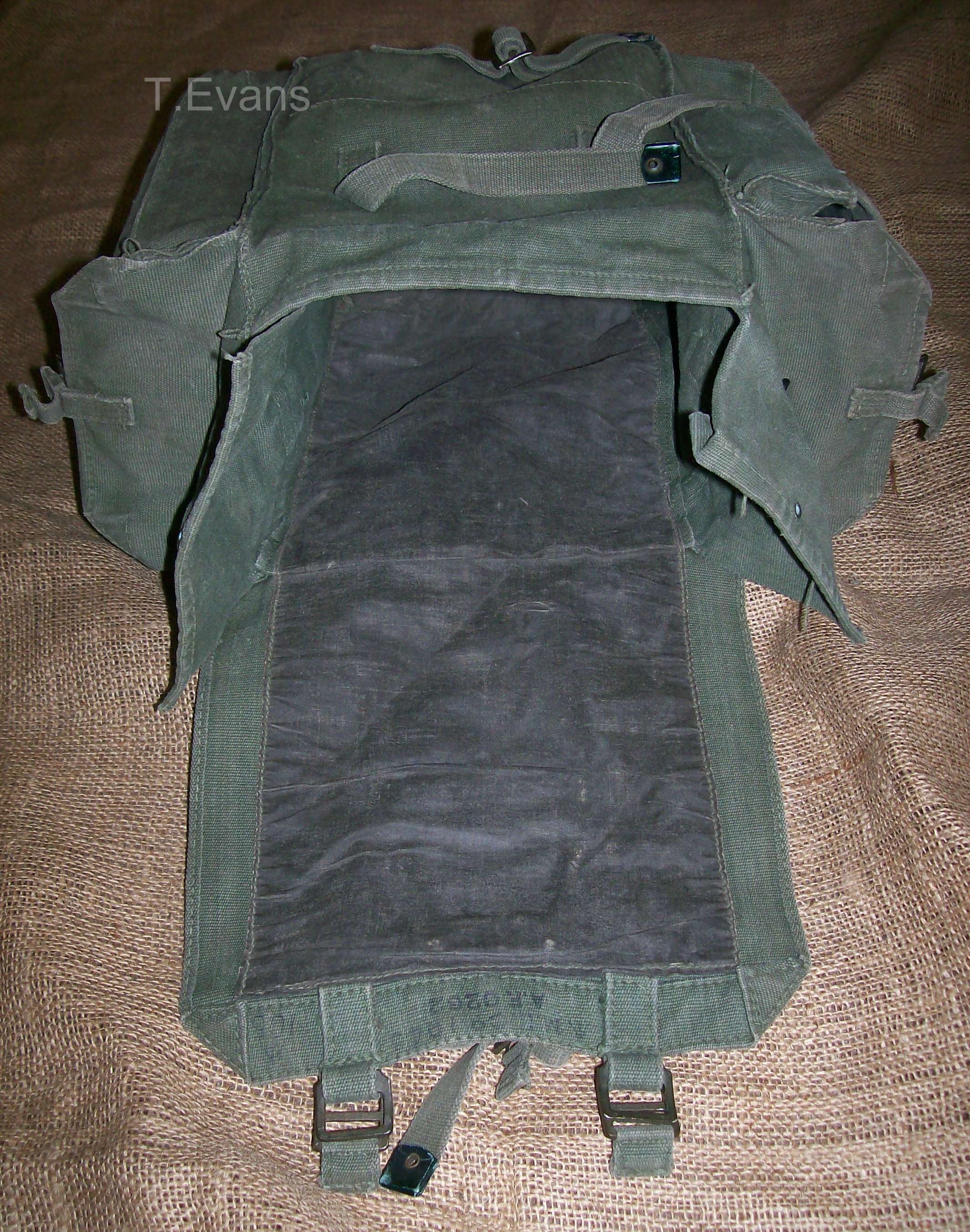
(h) Shoulder Straps.- 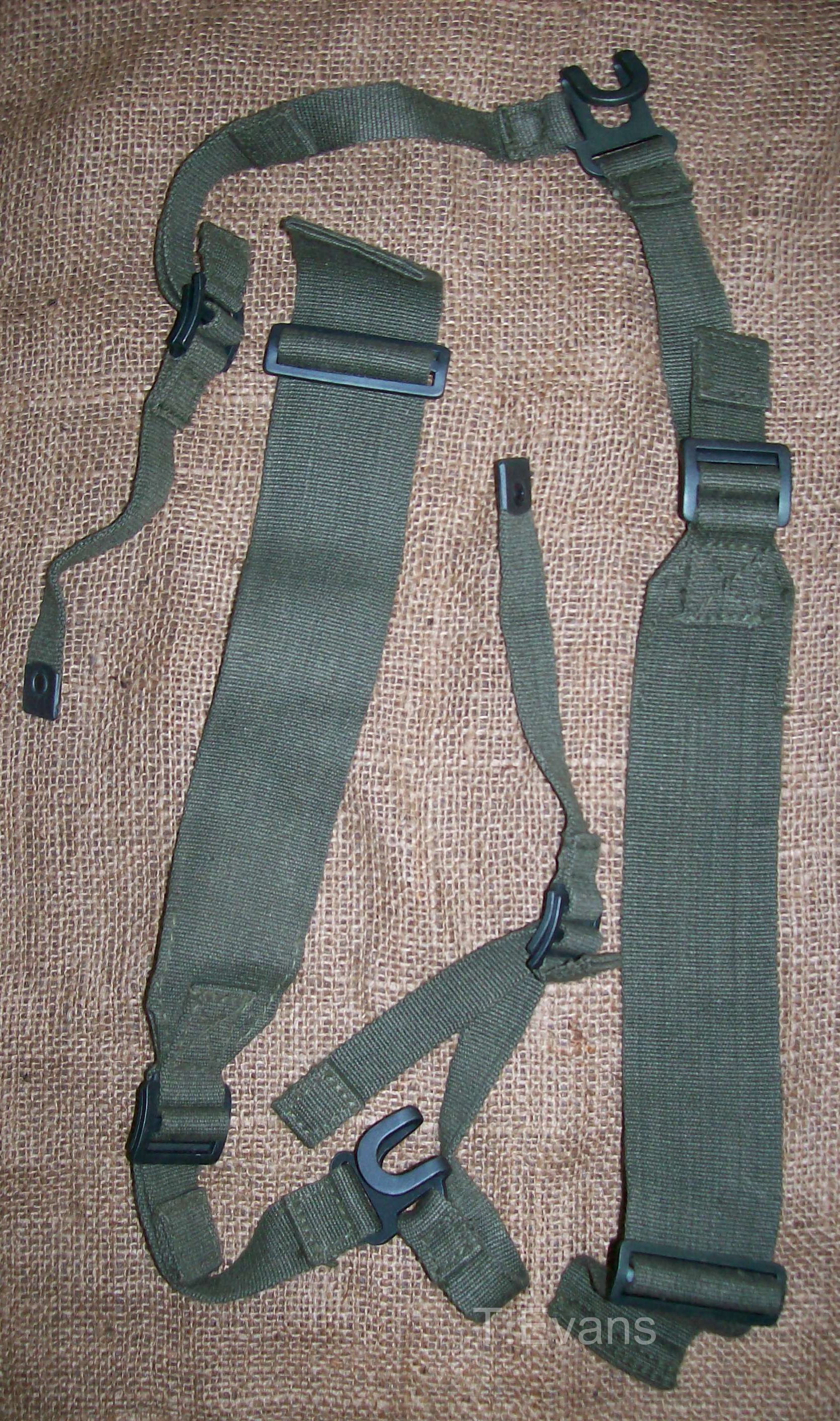 These are made left and right ; each consists of an integrally woven shoulder section, 2 inches wide tapering to 1 inch to carry a quick release buckle through which a strap with a hook is adjustable. To the "ear" on the side of the hook is sewn a narrow side supporting (or diagonal) strap which is adjustable through a quick-release buckle on a short strap, having a tip on the end for attachment to the corresponding buckle on the base of the haversack.
Rucksack.- This is made of light weight duck ; its dimensions are appoximately 14 inches by 6 inches by 18 inches deep (fully open). Large eyelets are equally spaced in the top hem and a draw cord is provided. It has a large closing flap having a flat pocket on the underside 8 inches deep, fitted with two patitions and a flap secured by quick-release fasteners. The large flap is closed by two 3/4- inch web straps and quick-release buckles. A large pocket about 10 inches by 3 inches by 12 inches deep, is provided on the front of the rucksack and there are pockets on each side 6 inches by 3 inches by 12 inches deep. All three pockets have "hooded" flaps with quick-releasefastners. The inner faces of the main closing flap and the centre pocket, as well as the inside of the hooded flap of this pocket, are lined with light-weight waterproof material. Webbing tabs and loops are fitted to the back and buckles on the base for attachment ot the shoulder straps previously described, Straps for an entrenching tool, similar to those on the haversack, are provided . On each side of the back wall of the rucksack three 1-inch "D" rings are fitted, equally spaced, to enable the rucksack to be secured to the Manpack Carrier, G.S., When required.